MonikondeeMonikondee
| Categories | Documentary Film |
|---|---|
| Accessibility | suitable for all age groups of minors |
| Languages | Sranan Tongo, Kalina, Wayana, Ndyuka, Pamaka, Aluku |
| Subtitles | English, Slovak |
| Black and white / colour | color |
For centuries, the Maroons in Suriname have kept capitalist society at bay. Descendants of enslaved Africans who escaped plantations, they survived by adhering to ancestral values. In recent years, however, economic interests have penetrated deep into the rainforest.
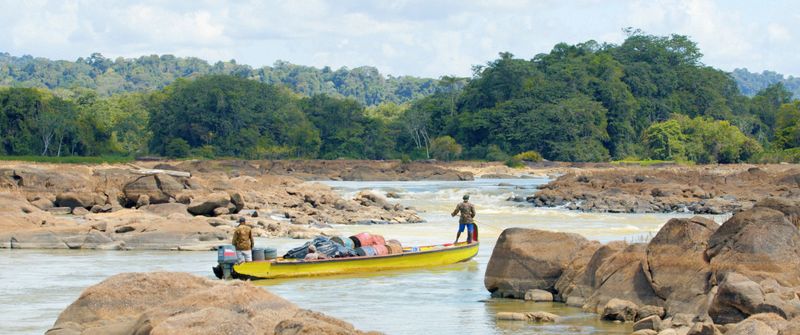
Monikondee follows boatman Boogie as he navigates the Maroni River, which forms the border between Suriname and French Guiana, to deliver essential cargo to remote Maroon and Indigenous communities. Despite growing their own food, , these communities are becoming increasingly dependent on boatmen for their daily provisions as climate-driven flooding and droughts are destroying their crops, and gold mining is poisoning the water. When Boogie is summoned by his clan leaders to attend his nephew’s trial, the demands of his work begin to conflict with his traditional duties. During a winding journey far upstream, the currents grow increasingly unpredictable.
Boogie is the film’s narrator, sharing this role with the people he encounters. The multi-voiced narrative draws inspiration from the mato, a collective Maroon storytelling technique in which the storyteller is interrupted by others who add their own stories and songs. The script was developed in dialogue with the participants, and in the film, they re-enact their own lives.
The film Monikondee won the Intangible Heritage Award at Cinéma du Réel 2025 in Paris (France).
---
.png)
Funded by the European Union. Views and opinions expressed are however those of the author(s) only and do not necessarily reflect those of the European Union or The European Education and Culture Executive Agency (EACEA). Neither the European Union nor the EACEA can be held responsible for them.
21 seats available |